Get started
4178 commitsLast commit ≈ 1 week ago190 stars72 forks
Chemotion ELN is an Open Source electronic lab notebook (ELN) for scientists working in chemistry and neighboring disciplines, developed mainly at Karlsruhe Institute of Technology (KIT). The web-based application allows the acquisition, management, storage, processing, and sharing of research data.
Chemotion ELN is an Open Source electronic lab notebook (ELN) for scientists working in chemistry and colleagues from neighboring disciplines such as materials sciences. Chemotion is mainly developed at Karlsruhe Institute of Technology (KIT). The software was built to offer a digitalization strategy for experimental sciences, contributing to the enhancement of FAIR and open data wherever possible. The web-based application allows the acquisition, management, storage, processing, and sharing of research data. The ELN provides access to various functions, helper tools, and external sources of information that facilitate the work with data and their analysis. Chemotion allows one of the most important improvements regarding sustainable scientific work: It supports chemistry researchers in academia to build their digital information databases as a prerequisite for the detailed, systematic investigation and evaluation of chemical reactions, chemical compounds, and related data.
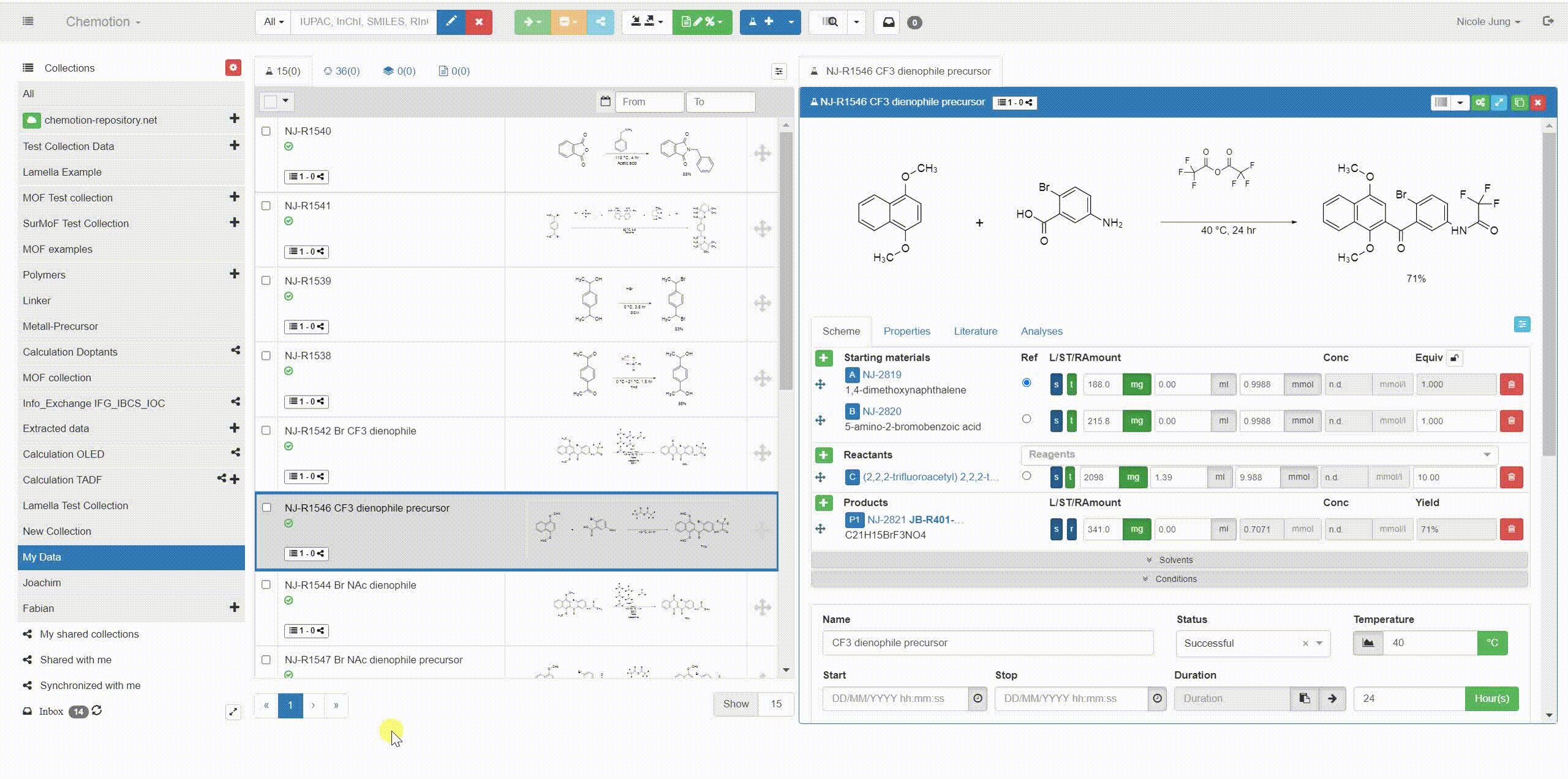 The screenshot shows an exemplary graphical user interface of Chemotion ELN.
Chemotion enables direct data transfer from devices into the ELN without requiring a separate LIMS software. A converter service standardizes various file formats for processing, visualization, and editing, combining in-house and open-source tools. Integrated data viewers (e.g., ChemSpectra, NMRium, R-based tools) allow data analysis within the ELN for e.g. NMR spectroscopic data, mass spectrometry data, cyclic voltammetry and many more techniques while preserving original and edited files.
Chemotion supports automatic metadata extraction from measurement data based on community-driven/accepted metadata schemas. The measurement type specific metadata templates are filled with information extracted from data files (from analytical instruments), information that results from the semantic environment of the ELN entries, and users' information, where applicable.
Chemotion offers customized (e.g., for samples, reactions, devices, cell lines, proteins), natively supported entities which offer well established models for the documentation of complex entities. For those, diverse dependencies and calculations have been implemented, reflecting the typical work processes in experimental labs.
In parallel to the natively supported entities, the LabIMotion extension offers community driven flexible models. LabIMotion enables feasible options to include other communities than the main target group chemistry, being a key component to the success to cover natural sciences and materials sciences with an increasing number of templates and functions.
The ELN offers interfaces to transfer information to repositories for research data. The interoperable transfer of research data is realized with the open access repository Chemotion, data collections can also be transferred directly to the research data repository RADAR. Taken together, the Chemotion systems offer a comprehensive research infrastructure for FAIR data management in chemistry, from the acquisition of data to their publication.
Electronic Laboratory Notebook (ELN) & Repository for Research Data (link to Youtube)