Get started
25568 commitsLast commit ≈ 5 months ago24 stars8 forks
ICON (Icosahedral Nonhydrostatic) is a flexible, scalable, high-performance modelling framework for weather, climate and environmental prediction . It is collaboratively developed and maintained by the ICON partnership (MPI-M, DWD, DKRZ, C2SM, KIT)
ICON (Icosahedral Nonhydrostatic) is a flexible, scalable, high-performance modelling framework for weather, climate, and environmental prediction. Developed and maintained collaboratively by the ICON partnership (MPI-M, DWD, DKRZ, C2SM, KIT), it brings together expertise from weather forecasting, climate research, environmental prediction, high-performance computing, and data science.
ICON is designed to cover a wide range of spatial and temporal scales and scientific applications. Its non-hydrostatic atmospheric dynamical core and flexible grid structure support global and regional simulations, from numerical weather prediction at operational scales to kilometre- and sub-kilometre-scale research simulations. ICON can also be used in large-eddy and single-column configurations.
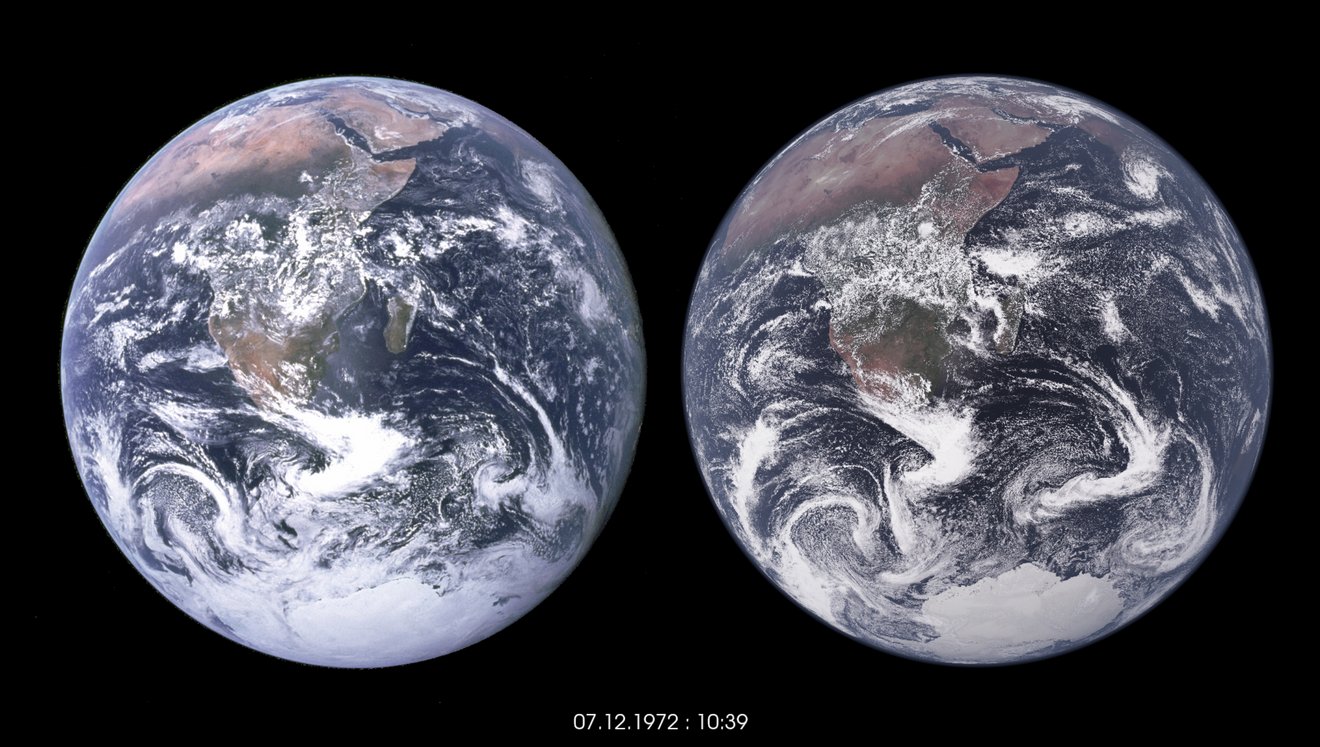
*Original NASA Blue Marble photo left, visualization right. Credit: MPI-M, DKRZ, NVIDIA
ICON provides a common modelling framework for different components of the Earth system. Depending on the configuration, it can represent the atmosphere, ocean, land, sea ice, surface waves, and atmospheric composition, with the components coupled to simulate their interactions.
Key application areas include:
The current ICON release supports global and regional NWP, high-resolution coupled climate simulations, and global and regional aerosol and chemistry experiments. ICON is also designed for portability across modern high-performance computing architectures, including CPU, vector, and GPU systems.
A major component of the ICON framework is ART (Aerosols and Reactive Trace gases), developed and provided by the Karlsruhe Institute of Technology (KIT). ART extends ICON with capabilities for simulating atmospheric gases, aerosol particles, and their interactions and feedbacks.
ICON-ART can represent processes including aerosol emissions, transport, chemical transformation, microphysical evolution, deposition, and interactions with radiation and clouds. It supports applications such as air-quality research, aerosol and climate studies, volcanic plume modelling, pollen and dust forecasting, and investigations of atmospheric chemistry and composition.
ART is integrated into the common ICON software ecosystem and is developed within the broader ICON partnership. This integration allows atmospheric composition processes to be simulated consistently with meteorology and, where appropriate, with coupled land and ocean components.
ICON is developed through a collaborative partnership involving research and operational institutions such as MPI-M, DWD, DKRZ, C2SM, KIT. The partnership brings together complementary expertise in weather prediction, climate modelling, atmospheric composition, Earth system science, high-performance computing, and data infrastructure.
The Karlsruhe Institute of Technology (KIT) contributes strongly to atmospheric composition modelling within ICON, primarily through the development of ART. Other partners contribute to the atmospheric dynamics and physics, ocean, land, wave, coupling, infrastructure, and other components of the framework.
Further information about the partnership and its members is available on the ICON partnership website.
Main ICON website:
https://www.icon-model.org/
ICON model documentation:
https://docs.icon-model.org/
Getting started:
https://docs.icon-model.org/getting_started/getting_started.html
Community exchange:
https://exchange.icon-model.org/
ICON releases:
https://docs.icon-model.org/release/release.html
ICON supported configurations
https://www.icon-model.org/icon_model/supported-configurations
ICON reference publications
https://www.icon-model.org/publications/reference-publications
ART documentation
https://www.icon-art.kit.edu/