All software

JUBE
JUBE is a generic, lightweight, configurable environment to run, monitor and analyse application execution in a systematic way. This software is commonly used to execute benchmarks and complex workflows on High Performance Computers, but is not limited to these systems.
- Benchmark
- Benchmarking
- High performance computing
- + 5
- Python
- Shell
- C

MLAir
MLAir (Machine Learning on Air data) is an environment that simplifies and accelerates the creation of new machine learning (ML) models for the analysis and forecasting of meteorological and air quality time series.
- Python
- Shell
- Jupyter Notebook
- + 2
PeriLab
PeriLab is a Software to solve Peridynamic problems. It is written in Julia to overcome many issues related to the Software Peridigm.
- High performance computing
- julialang
- Peridynamics
- + 1
- Julia
- G-code
- Batchfile
- + 3

Prospective Monitoring and Management - App (PIA)
PIA is a free open-source eResearch System for monitoring of incident events and provides a digital infrastructure for conducting population-based studies in any research field - at a study centre or at home. PIA focuses on repeated surveys. #DigitalEpidemiology #LongitudinalDataCollection #FOSS
- Data Collection
- Digital Infrastructure
- epidemiology
- + 5
- TypeScript
- HTML
- JavaScript
- + 11

PedPy
PedPy is a Python library for the analysis of pedestrian movement data.
- pedestrian analysis
- pedestrian dynamics
- research software
- Pascal
- Python
- Jupyter Notebook
- + 1
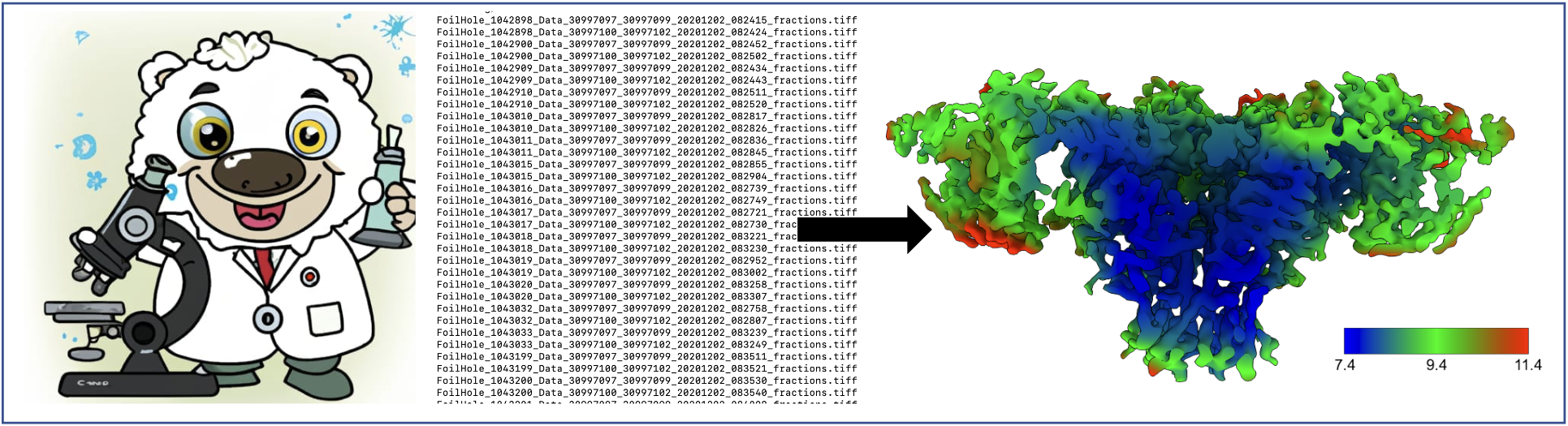
TomoBEAR
TomoBEAR is an open-source configurable and customizable modular pipeline for streamlined and parallelized processing of large-scale cryo-electron tomography data for subtomogram averaging.
- Alignment
- automated reasoning
- cluster
- + 16
- MATLAB
- M
- Python
- + 1

atoMEC
atoMEC is a python-based average-atom code for simulations of high energy density phenomena such as in warm dense matter. It is designed as an open-source and modular python package.
- Matter
- Python
- Shell
SicHash
A perfect hash function is a function that has no collisions on a given set. SicHash places objects in a cuckoo hash table and then stores the final hash function choice of each object in a retrieval data structure. Using irregular cuckoo hashing, each object has a different number of hash functions
- C++
- TeX
- Shell
- + 2

PaN Training Catalogue for the Photon & Neutron Community
The PaN Training Catalogue is a fork from the TeSS Training Catalogue (ELIXIR) and was initially developed in our Photon and Neutron (PaN) projects ExPaNDS and PaNOSC.
- catalogue
- e-learning
- metadata
- + 3
- Ruby
- HTML
- JavaScript
- + 4

ELECTRODE
ELECTRODE extends the atomistic simulation tool LAMMPS to model different types of electrochemical situations. Simulations are performed at constant potential or constant charge using different approaches to control potential or charge at the electrodes.
- Constant Potential Method
- Electrochemistry
- Molecular Dynamics
- C++
- Tcl
- Cuda
- + 24

LLAMA
LLAMA is a cross-platform C++17/C++20 header-only template library for the abstraction of data layout and memory access. It separates the view of the algorithm on the memory and the real data layout in the background.
- C++
- heterogeneous computing
- High performance computing
- + 3
- C++
- CMake
- Shell
ShockHash
A perfect hash function is a function that has no collisions on a given set. ShockHash constructs very compact perfect hash functions significantly faster than previous approaches.
- C++
- CMake
- Shell